P&G: A Blueprint for Indispensable Brands
July 24, 2025
Watch and subscribe:

July 23, 2025
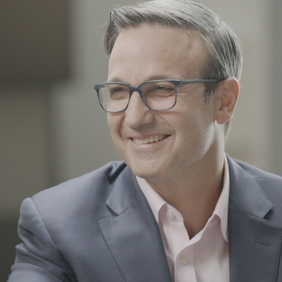
Morgan Stanley Research sits down with Procter & Gamble CEO Jon Moeller to discuss how the company is reimagining its business model while continuing to develop some of the world’s most indispensable household products.
JON
The answer isn't in the box. It's not in the model. The answer is in human hearts and minds. And we need to be present and in touch with their fears, their anxieties, their concerns, their needs. If we do that, well, you’ve seen the kind of success that's possible.
DARA (V.O.)
For nearly two centuries, Procter & Gamble has been at the forefront of innovation—addressing everyday household needs—to create some of the world’s most valuable, as well as indispensable, consumer brands. But innovation at P&G isn’t just about reimagining products—it’s also about rethinking strategy. Under CEO Jon Moeller, the Cincinnati-based company restructured itself over the last decade, culling its portfolio to focus on the higher growth and more profitable categories, aggressively cutting costs, reorganizing its corporate structure, and modernizing its supply chain. The stock has since doubled since the summer of 2018, as Procter continues its relentless focus on product superiority. I wanted to learn more about what it takes to leads a company, with more than 100,000 employees and 5 billion consumers worldwide, through such significant change. So, we sat down with Jon to talk about what sparked P&G’s transformation, how the company is using AI and open innovation, and where he sees the biggest growth opportunities in the decade ahead.
DARA
Thanks so much for coming out today. Really excited to have you here.
JON
Thanks for having me.
DARA
I thought maybe first we could start going back to your CFO days and early in your tenure as CEO. You went through what I consider to be the biggest modern-day turnaround we've seen in CPG history. Was there an “aha moment” where you really realized that you needed to make significant change?
JON
We were tired of losing. We define winning as being in the top third, from an operating total shareholder return standpoint, and we weren't [in it]. And that wasn't okay. It wasn't okay for me; it wasn't okay for any of us. We knew we had to make significant changes. And so we started from a common understanding of, at least, the need. And from there, it was really analyzing what was holding us back from achieving those objectives, both culturally and from a strategy standpoint. And we operated with data, in terms of helping our organization understand why these things were going to change the trajectory going forward. It involved developing a common understanding of what the challenges were [and] importantly what the opportunities were, and then starting to deliver against those, and seeing the results inflect and start to improve. And then it was off to the races.
DARA
We've seen peers, I think in many cases, emulate some of your strategies and come back even more aggressively. As you think about leading the group going forward from here, how do you drive superior value relative to that competition?
JON
The way to stay ahead of competition is just to keep running faster. If we look at the six years since we put this strategy in place, the team has grown sales by $17 billion dollars, which puts us in the 85th percentile of the S&P 500—actually, the 87th—and growing profit $5 billion dollars after tax, which puts us at the 93rd percentile of the S&P 500. So, it's not just versus competition; it’s across swaths of industry. During that period, the team created $200 billion dollars in additional market cap: more value creation in those six years than any of our competitors have created over their entire one-and-two-century histories as a company. We created the 17th most valuable publicly traded company in the US; the 22nd most valuable in the world. That is no reason for future success, but it gives us a lot of confidence that what we've been working on makes a difference and actually widens the gap over time.
DARA
You have the greatest stable of brands in the world: Pampers, Tide, Gillette. We could go on and on. What are some of the common links behind the success of those brands, as you look back over your long history? And how do you make them relevant to today's consumer, as we look going forward?
JON
Fundamentally, success is driven by the degree to which we can solve a consumer's daily tensions in his or her life, improve their lives in the process, and communicate the benefit and the value that's delivered by those propositions. And when we do that well against true consumer needs—not imagined on our part or desired on our part, but truly expressed by consumers—amazing things happen. And when we lose sight of that consumer, which we've done at times, everything falls apart.
DARA
Take us through how you incrementally drive success on that product superiority metric going forward.
JON
We start every business discussion with, “Tell me how you're going to grow the market.” That establishes a very high bar for innovation, commercialization, operationalization. The answer is through continued increases in superiority, which drive consumer delight, which drive customer delight. We used to start with: how are you going to gain share? That's not a question that I want us to be asking. I want to be asking: how do we create business versus take business? If we disproportionately contribute to the creation of these markets and the growth of these markets, we will, by definition, build share. So that's the mindset. The world around us changes every day. Our job is to get up each morning and put two feet on the floor and optimize against that change in reality, in a way that continually grows our margin of advantage.
From an R&D standpoint, obviously we've had a lot of technological advancements in recent years. Where do you think sort of innovation’s going? What are the functional areas that you can use to drive value with consumers? The speed with which we can test different solutions, and their compatibility with each other, has gone up 50 times. And I don't see any reason why that doesn't continue to be an exponential curve. The role of biology will become more and more important. So, it's one of the reasons we continue to look for productivity opportunities to invest in innovation, which is, we spend more on innovation today—on R&D—than any of our competitors, and most of our competitors combined.
DARA
As you look out over the next decade, what do you think could be the biggest value drivers for your company, taking a longer-term point of view?
JON
If you just look at household penetration of our products today—and let's take a mature market like the U.S.—there is significant upside. Something like laundry scent beads are only purchased by 50% of households in the US, and they only use them in about 50% of the laundry loads they do in their home. So, if we simply got that to 75, 80%, both in terms of household penetration and load penetration, the upside would be massive. And that same opportunity exists across most of the categories. Ideally with the objective of 100% satisfaction to customers, perfect service at much lower costs, with much better jobs in the process. And that's a multibillion-dollar opportunity. The ones that might seem more counterintuitive, but I think are the most powerful, [are]: dramatic increases in the value proposition for each employee. When you get that right, and everybody is thrilled with the work they're doing, the recognition they get for doing that work, [and] the compensation they get for doing that work, the world changes and that affects every part of the activity system. So that's one of our four focus areas, is ensuring that we're doing that better than anybody else, better every day than the day before.
DARA
How do you think P&G can increasingly use AI, just technological advancements in general, or scale to your advantage? And how do you partner with your retailers also to drive that advantage?
JON
So, there are two things that we're actively working to change in a constructive way [in] the relationship with our retail partners. Historically, we looked at things in very transactional ways. Therefore, we've been historically unwilling to truly cooperate. And I think that's a huge loss opportunity and mistake. We can bring, as a very large-scale manufacturer, immediate benefits to that equation with our retail partners, making us a preferred partner to work on some of these solutions, even getting to the point where we can share data—which was sacrosanct for many years—in an appropriate way that combines our data sets, their data sets, [and] consumption or purchase data in the store, all together.
And bring AI technology to understand, you know, what's the best shelf configuration? What's the best product assortment across that shelf? What media channels, including retail media, are actually growing the market, driving trips, driving baskets? It's a very, very different way of thinking about things. I think also, we have to think differently about innovation than we have historically.
We have approached it for decades as a search for proprietary advantage, what I call, Closed Arm Innovation System. There are opportunities to take innovation that P&G has and make it available to the broader community, both competitors and multiple industries. If you think about some of the challenges in environmental sustainability, no one company is going to solve those—they can't afford to. The scale that's required to make those technologies affordable surpasses the capacity of any one company. You know, you mentioned the scale, you mentioned new technologies; bringing those together in very, very different ways than we thought about historically, I think, will yield some exciting outcomes.
DARA
What's some of the most important advice you've received, either from your CEO predecessors or other executives, that's helped you lead the P&G organization?
JON
One of the most motivating comments I received one time was from a board member, and I was taking them through one of the challenges we had and trying to assure them that everything was going to be all right, and this board member looked at me and said, “Jon, when you're explaining, you're losing.” I didn't like that. But that person was correct. I think the other is: you're one person in a company of today, 108,000 people. You can accomplish very little by yourself. So it's about energizing and motivating and, in a constructive way, holding accountable the balance of the organization that moves things forward.
DARA
Thanks so much for coming out today. Really excited to have you here. And, as always, incredibly informative.
JON
Thank you.
July 24, 2025
In this engaging series from Morgan Stanley, experts from across the firm sit down with leaders at world-class companies for insightful conversations covering everything from leadership lessons to foundational changes in industries, markets and society.
Coming soon
Coming soon
Sign up to get Morgan Stanley’s Five Ideas newsletter delivered weekly to your inbox.
Subscribed!
Thank you for subscribing to our blog newsletter. Stay tuned to hear about Morgan Stanley ideas!


