Exceptional Leaders: Wellhub’s Cesar Carvalho
April 27, 2026
Watch, Listen and Subscribe:

April 27, 2026
Wellhub CEO & Co-Founder Cesar Carvalho shares his perspective on how companies are rethinking wellness, moving beyond perks to strategic investments in their people. As the company’s fast-growing digital platform continues to reshape how organizations support employee health, Carvalho highlights a clear shift: Businesses are recognizing that well-being isn’t just good for employees—it’s good for financial performance, too.
Salem
The concept of wellness is no longer just about burning fat and building muscle. It’s expanded into something far more holistic, including how we eat, how we sleep and how we manage stress. Corporate attitudes towards well-being have also changed.
Carvalho
Employee well-being is being discussed at boards now because the liability of not having employee well-being is super high. And it’s going to be even more relevant going forward.
Salem
One leader who saw this shift long before it became mainstream is Wellhub’s CEO and co-founder, Cesar Carvalho.
Carvalho
The next step is corporate well-being becoming a standard that every single company has to offer, that every single employee demands their employer to do.
Salem
His vision turned the company into a multi-billion-dollar business that is reshaping how organizations and employees think about wellness. As part of Morgan Stanley’s Investment Banking team, I’ve had a front-row seat to Wellhub’s remarkable expansion. I sat down with Cesar recently to talk about the company’s journey and where the future of wellness is headed.
Salem
Cesar, it's great to have you here.
Carvalho
Thank you for having me. Great to be here as well.
Salem
For those who are not familiar with Wellhub, tell us a little bit about what you guys do.
Carvalho
Wellhub is a technology company that's making well-being accessible to every single employee. And we're also helping change behaviors for the better at scale. And right now, we work with more than 40,000 corporate clients, and we have over 5 million paid subscribers. Those subscribers are visiting more than 100,000 partners—different gyms, studios and apps—more accessible, more flexible, and have more options than any traditional gym membership.
Salem
What was it that inspired you to do this?
Carvalho
Growing up in the countryside in a rural area, I've always had well-being close to heart. I was a super active kid with sports and etcetera, and when I started working, they all went away and I completely forgot about that part of my life. I was doing my MBA, and I took a break. And I noticed there was an opportunity here to bring those two worlds together again and help not only myself but every single other employee who was struggling with not keeping up with well-being. And that was when I decided to drop out of my MBA to pursue this amazing mission. And 13 years later, here I am still driving it forward.
Salem
How has corporate well-being evolved, you know, across all companies and their attitudes towards offering this type of thing to employees?
Carvalho
It started as a cost center, and now it has already moved into an investment strategy and part of the overall strategy for companies. Well-being used to be an app for meditation, an app for nutrition, an app for physical activity, some partnerships with gyms nearby the office, or maybe an in-company gym. And the problem with those legacy solutions is that the employee participation on those are extremely low. The new version of employee well-being is very different. It's about engagement. It's about the products employees would use every single month, many times per week.
Salem
The ecosystem that Wellhub has, from the companies to the wellness partners to the employees: it's very powerful. And I want you to talk through a little bit the interplay across those three groups.
Carvalho
Starting with the employees: they have access to a membership that never existed in the well-being space. It costs less than a traditional gym membership but gives every single employee access to thousands of locations, many different wellness apps for physical activity, nutrition, sleep, meditation, and therapy. The companies that are clients of Wellhub love the products we bring to them, because we get a lot of those people who were not previously active, were not previously engaging with well-being, to sign up for the first time. They want to invest, to get those people to change behaviors for the better, and they reap the benefits as well. And the last part of the equation here are our wellness partners: the different gyms, studios, and apps we work with that are included in our memberships. Because we're getting a lot of new people into this ecosystem, they're getting incremental revenue, they're increasing their earnings. Our ecosystem is the reason why our model is so robust and why also it's growing super-fast.
Salem
In December of 2025, Wellhub reached a significant milestone: one billion check-ins, representing a tenfold increase in just three years. That means one billion moments when subscribers visited a gym, took an online fitness class, or paused for a mindfulness break. For Cesar, this growth reflects a broader shift: companies and employees are placing ever greater value on health and fitness.
Salem
What is the business case to the company itself?
Carvalho
We help people change behaviors and get to a healthier life. And we track ROI in three different fronts. The first one is health care costs. Health care cost is probably the single largest expense after payroll for every single company. That cost is growing at a very fast pace, and prevention is the key to save 70% of those costs. And even though that's obvious, only 4% of all spend goes into prevention. A second part is on employee retention and the acquisition of talent. And it's going to be quite clear, for the employees currently working in the company and for prospective employees, that those companies who are embracing well-being, that they care about them. And those companies are going to have an amazing ability to attract people over time and retain the best talent. The last part is on sick leaves. Employees who are active or constantly exercising our engagement with well-being take fewer days off, and therefore they contribute more, not only to their families, to their lives because they're being productive, not sick, but also to their companies as well.
Salem
In 2019, Cesar decided to move the company’s headquarters from Sao Paulo to New York. Since then, Wellhub has rapidly expanded into major U.S. markets. But growth doesn’t stop in the Americas.
Talk to me about your strategy for further international expansion.
Carvalho
Most companies start in the U.S., they grow very fast, and then they sort the international piece afterwards, and then they struggle with the different currencies, languages, and the localization strategy for every single small market. I think the benefit of Wellhub is that we sorted that international piece first. We sorted the complexity, and we solved for it. And now our most important challenge, which we're executing successfully, is scaling very fast in the U.S., a huge market where well-being is more prevalent than in other places, and it's at the forefront of innovation in this space.
Salem
The fact that wellness partners are incentivized to join the platform does make you very insulated from the different things that change in the fitness and wellness industry.
Carvalho
I've been doing this for 13 years. It happens all the time. It's like the movies industry: there's a new blockbuster every year. You know, pickleball was the most recent one in the U.S. There are new ones coming. You know, CrossFit was at the peak at some point in time. Zumba, you know, and it will keep happening. And this is what keeps well-being fresh and why companies are better off picking a platform that's constantly getting better over time, versus trying to build each one of these solutions on their own to each of their employees.
Salem
After stepping away from a traditional corporate path to build a company that reimagines work-life balance, Cesar is now on a mission to turn every organization into a wellness company: one where employees check in with their well-being every day. And that philosophy starts with him.
Salem
I’ve gotta know, a day-in-the-life of the CEO of Wellhub, what are you doing start to finish?
Carvalho
It starts with a high-intensity workout, a sauna and a shower, before I jump into calls with my team. I try to have a healthy lunch, some meditation, calls with our clients and partners to get feedback and build a better product. I try to use Headspace so I can meditate and to hear sleep stories so I can go to bed on a high note. Look, I use Wellhub every single day: visiting our partners, trying different activities. And to me, that is what makes me a better CEO. But in addition to using Wellhub every single day, even when I'm traveling—last week I was in Germany, used our international check-ins to visit Holmes Place there. This morning we're here at Life Time. I already did my check in the morning, you know, to exercise before I work, so I try to integrate it in my routine. I try to meet with my team in healthy events. You know, so instead of going to a bar, why don't we do a yoga class together or a meditation session together? Meeting with our partners or vendors: why not to do it in a healthy way so that we build on those habits?
Salem
Can you talk a little bit about your leadership style? How are you able to inspire your employees?
Carvalho
If I had to pick two words, I would pick “empower” and “trust.” Empower because I deeply believe all the decisions in the company, they need to be made, either by my direct reports or by their direct reports. And I'm very big on pushing decision-making down so that we can be the best at making those decisions, considering the perspective of whoever is running the business closest to action. The second thing about trust is about treating employees like adults, giving them flexibility if they need the chance to, like, prioritize well-being and still deliver the results that are expected of them.
Salem
If I were to go 20 years into the future and look back, what is the type of legacy that you personally and your company would like to leave?
Carvalho
What we're building here is not only critical for individuals themselves—you know, if you're active, if you're exercising, we're going to live longer and we're going to live better lives as well—but this is also critical for society and for companies. My legacy, I want it to be to have every single company be also perceived as a wellness company. And I want well-being not to be something employees do twice a week but for it to be a daily habit. And if that happens in the world, I think my kids are going to live in a better world 20 years from today, and that will be an amazing legacy every person would be very proud to live.
Salem
Cesar, thank you so much for being here. It was great catching up and learning more about the company.
Carvalho
Thank you for having me, Emeel.
Salem
The day is not over, though, until we do a workout.
Carvalho
Let’s go for a workout together.
In this engaging series from Morgan Stanley, experts from across the firm sit down with leaders at world-class companies for insightful conversations covering everything from leadership lessons to foundational changes in industries, markets and society.

JAMES QUINCEY
The future belongs to the discontented. Robert Woodruff wrote that in 1936 on the 50th anniversary of Coke. If we rest on our laurels. If we think the future is owed to us, it'll be a catastrophe. The people who are trying to think a little harder about how to satisfy the consumer needs is going to win.
V.O. (DARA MOHSENIAN)
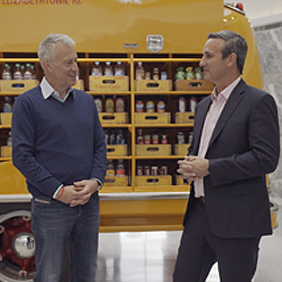
From its pharmacy beginnings in 1886, Coca-Cola has become more than just a beverage company. It's one of the most iconic brands of all time, simultaneously evoking nostalgia as well as optimism for a brighter future. Of course, enduring brands need visionary leaders. And that's where James Quincey comes in. Since stepping into Coke’s CEO role in 2017, Quincey has guided the company through a period of profound transformation, refocusing Coke as a total beverage company, flattening the corporate structure, and emboldening the organization to take smart risks. All while keeping up with ever evolving consumer tastes. As an analyst covering U.S. Beverages and Household Products, I've been closely following Quincy's career and was eager to meet with him ahead of his March 2026 retirement. So, I traveled to Coca-Cola's global headquarters in Atlanta, saw more than a century's worth of memorabilia, visited the vault holding Coke's original secret formula, and sat down for a fascinating conversation with Quincey about leadership, legacy, and the enduring power of an exceptional brand.
DARA MOHSENIAN
James, thank you so much for being here, this is an incredible opportunity. We're excited about it.
JAMES QUINCEY
Pleasure.
DARA MOHSENIAN
So, Coke has 30 separate billion-dollar brands. You've locked away the secret formula in your vault, which I saw this morning. But what's the secret to building billion-dollar brands in your mind?
JAMES QUINCEY
you need to have a sort of messianic belief in an idea. The brand, what it does, what problem it solves the consumer. If you don't have a messianic belief in it, you'll never go through all the hard things that are ahead on building a brand. And yet, on the other hand, it's very rarely right first time. You know, you can name zillions of companies, they came up with an idea. And then through three, four, five iterations, they ended up with something really, really good. And that's what they're famous for now, but they generally started as something else. And that's true of brands as well.
How do you manage the tension between believing in something and yet still being adaptable to the feedback from the consumer? And that's kind of key to creating these brands. I mean, you think about Coca-Cola, it's not the first formula we tried. Right, you know, John Poundland, he used to go down to the port of Savannah and buy different spices and ingredients and go back and mix them together. So, there was an iterative process there of coming up, not just with the brand, but with the product that typifies it. It's not all, it's not all science. There's definitely some art to it, too, and listening to the consumer.
DARA MOHSENIAN
At a consumer level. How do you really conceptualize what can work in a big way in this environment?
JAMES QUINCEY
in the end, you're trying to solve a problem for the consumer. They may not know they've got the problem. They're not answering it directly from the need. it's like, how do you solve the problems they've got with dealing with, all the people coming through the doors trying to buy beverages. And that's, you know, the advent of the fountain machine or the vending machine. Really, starting with the consumer. I think it's a great enduring lesson of the importance of understanding deeply what is the consumer really interested in?
DARA MOHSENIAN
Let's go back to 1996, when you joined Coca-Cola as an organization.
JAMES QUINCEY
Coca-Cola was a bit of iconography around, you know, the American dream or the dream of freedom and all those things. So, of course, it was kind of embedded in my mind. And, you know, I can remember playing squash with my dad and drinking a Coke afterwards. So again, everyone has an integration of the brand into their life. It was clearly a brand I loved and therefore - and there was this moment of serendipity - so I came in and joined the company. I thought, let's give it a try. Let's see what happens.
DARA MOHSENIAN
Talk about your leadership style and how it's evolved at Coke over time.
JAMES QUINCEY
I mean, I've been here almost 30 years. And, you know, you learn and mature. You learn from your own experiences. Like, ‘okay, this works. This doesn't work. That's not so smart. And let's do something better.’ You learn from seeing leaders you admire, and frankly, leaders you don't admire. Okay. Well, I'm not going to follow that example. And so there's been a natural process of learning and growing, and maturing over the 30 years and to some extent, you know, as you go up in the organization, you start off kind of very focused on getting stuff done. And it gets a little more conceptual as you get up to the top of the organization. But it's really been a steady process of learning and growing, which at the end, what does it require? It means it requires you to be open to getting the feedback, and incorporating new ideas and new ways of doing things.
DARA MOHSENIAN
Coke's truly a global beverage company. How does that impact the way you manage the company, your leadership, the global orientation?
JAMES QUINCEY
Well, firstly, I think that that experience, talks to the possibilities at Coke, which is you can go almost anywhere in the world and have different management experiences. And it demonstrates the globalness of the organization that you can be almost anywhere. But each of those experiences was different. And that talks to the localness of the business. You know, running Argentina is very different to running Mexico is different to running Europe. Each of these businesses in each of these countries has something very unique about it. You know, and I was the Argentine country manager in their crisis in 2001- 2002.
DARA MOHSENIAN
Fun times.
JAMES QUINCEY
Yeah, I arrived in the country - it was one of the most expensive places in the world. A few years later when I left, it was one of the cheapest. And, you know, everything can change overnight in some of these countries. The premium on agility, the willingness to reconsider everything from first principles, having a very broad view of the organization because all variables can come into play at any time. You need to be much more holistic, and much quicker, and much more willing, to change things on a dime. And also, the results can be much better on the way up. And they can be much worse on the way down. And then you go to a Europe where that generally is not true. Not all variables at play at the same time.
The difference between good and bad is a much smaller margin of error. It feels more institutional and set piece. But then of course it puts the premium or puts the intensity on the of the competition on those few variables that are in play at a much higher level than perhaps you would have in a Latin America or an emerging market. So, I think being able to learn each of those different experiences makes it much better as a platform to then try and run the global company.
DARA MOHSENIAN
Can you highlight the emerging markets opportunity you see over time?
JAMES QUINCEY
The simplest way, I think, to think about the global beverage market. And as we're talking beverages, think two bottles. You’ve got one bottle that's the developed economies. That's about 20% of the world's population. In that bottle people are paying for about 75% of what they drink each day.
So commercial beverages largely fills the bottle in the developed economies. Of course, that's made up of alcohol, nonalcoholic drinks, coffee, tea, etc., etc.. And our share is, you know, in the low teens of the total commercial beverages. We don't play in every piece, but it's a relatively low share of the total money. So, we got lots of opportunities to continue to gain share of the money that's being spent in the developed economies for the beverage share. But that's just the developed market, which is 20% of the world's population.
The other bottle actually represents largely the emerging markets. That's 80% of the world's population. And there they are only paying for two and a half of the drinks out of ten that they're consuming. And our share is, I think, high single digits. So, actually, the most important feature of the global beverage industry is it's yet to be created, is the empty emerging market bottle. As the industry leader, we can help grow. And obviously, we think we can gain share in both the developed and the emerging markets as we do.
DARA MOHSENIAN
When you came in as Coke’s CEO, you really refocused the company from primarily a soft drinks focus. And you talked a lot about making Coke a ‘total beverage company.’ Could you talk about the genesis behind that thinking and how you've evolved the company?
JAMES QUINCEY
People had realized we needed to be a broader beverage company before, and had tried to break out. But it was left at the intellectual level. And the culture basically ate the idea and stopped it. The company was very much culturally - Coke first, second and third without any opportunity. And every country gets to decide and they can keep changing everything.
Once you've got that, it’s very difficult to galvanize about a new idea that you need to move around. Because everything got relitigated. And everything got subsumed to Coke's. Actually, the insight in a way and the action was to resell the idea of a total beverage company in a compelling way, and bring with that a cultural change strategy that allowed it to then prosper and thrive within the evolved company.
DARA MOHSENIAN
Culture has been a huge focus for you at Coke. One of the seminal moments was when you showed up for the first analyst day in jeans.
JAMES QUINCEY
The jeans moment was, in a way, leveraging the simple idea that everything communicates. To say ‘things are going to be different’ because it was a very formal, hierarchical, but very formal organization. Here's the moment of change. It was reinforcing the idea ‘We’ve got to be different.’ And the culture had become very inward looking. It's a large organization. It became inward looking because things got very hard to do. So of course, you direct more energy internally. And we very much had to push the idea of a growth mindset, and understanding that everything we did communicated or reinforced that strategy. And the simple mechanism I used to give to people is ‘every time you do something that is coherent with what you said you wanted, you score a point. And every time you do something that's not coherent with what you said you wanted, you get minus ten.’ If you can't get into positive numbers, you’ve got zero chance of changing the culture.
DARA MOHSENIAN
AI seems to be transforming everything at this point. Where do you think it could be most impactful for Coke?
JAMES QUINCEY
in the long run, I think it's most interesting as a demand creation, consumer engagement, retailer engagement vehicle. In the short term, I think it's more likely to be productivity. That's where it's easier to see it's impact, whether it's the effectiveness with which you make the Christmas ad or some of the other things we've been doing, helping the salespeople be much more effective.
I think those sorts of examples, are the near-in ones, which are kind of easy to grasp. As it goes forward and as AI systems of Coke can talk to the AI systems at the retailer, can interact with the consumer's AI systems, then really it's about demand creation and competitive advantage.
DARA MOHSENIAN
You've had an incredible tenure as CEO over the last decade.
JAMES QUINCEY
Thank you.
DARA MOHSENIAN
How do you ensure the organization is positioned for success post your tenure?
JAMES QUINCEY
Actually, it starts on day one. It's one of those kind of weird experiences on being a CEO. You start and immediately begin the conversation of how to replace yourself. It's kind of, it's sort of unique in that way. And you do. That's what we and you know, the board and I have been doing ongoing all through my tenure is stewarding all the talent down through organization.
Think of it as a huge kind of funnel, if you like, giving people opportunities to grow, promoting the ones with the best and the most long-term potential, and constantly looking for a stream of successes to each job and ultimately successes to the CEO job. So, it’s been an ongoing process. You can't start the day before you want it. It has to be something both for the CEO and the organization that's an enduring and ongoing piece of the management development program.
DARA MOHSENIAN
Looking ahead, what's still on your agenda?
JAMES QUINCEY
I used to say something like, ‘well, hopefully there'll be nothing left to do,’ but that is a wildly naive thing to say because the reality is the world keeps changing. Consumers needs have an enduring part to them, but they also have, kind of, they come in new forms of manifestations. How and where you will engage with them has changed. So, if you just look at the journey of marketing over the hundred and four years of the Coke Company, it's gone from, you know, started with sampling, then it's got ads in newspapers, then it's got billboards, then it's got radio, then it's got TV, then it's got social media. Now we're kind of on the verge of the agentic agent. The consumer is still there with a need to drink liquids.
But how you engage is changed every time. So, really the challenge will always be, and it will be an enduring challenge, is how do you make the brands relevant to every generation of consumers? How and where do you make that happen? And that'll be an eternal job.
DARA MOHSENIAN
How do you think you'll be remembered as Coke’s CEO?
JAMES QUINCEY
I used to say, ‘I hope I'm not remembered.’ But I'm not sure that's a very good answer. I hope there's a degree of fondness and success and respect. But at the end, the important thing about history is that recent history should not be marshaled in service of the future.
JAMES QUINCEY
You know, I hope they forget me. Not because they didn't like me or they didn't think it was good what I did. But the future is so full of growth, has so many opportunities, and they're so successful that they're looking forward and not looking at the recent past.
DARA MOHSENIAN
Well as always, that was very informative. Thank you so much for being here.
JAMES QUINCEY
Thank you.
SIMEON GUTMAN (V.O.)
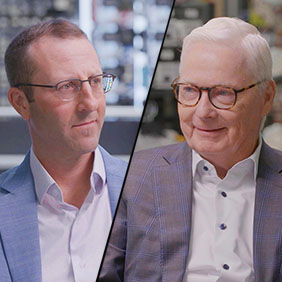
When Ed Stack took over Dick's Sporting Goods in 1984, his main objective was keeping the family business afloat.
ED STACK
We weren’t very well capitalized. Certain brands wouldn’t sell us at the time.
SIMEON GUTMAN (V.O.)
Today, Dick’s is the dominant player in sporting goods, with more than 850 stores across nearly every state in America. And it is one of the most innovative names in retail, connecting with customers through immersive experiences in the store, on the playing field, and digitally. Ed's vision.
ED STACK
To be the best sports company in the world.
SIMEON GUTMAN (V.O.)
As an analyst covering hard lines in broadline retail, I wanted to learn more about how Ed, whose father founded Dick's in 1948, has led the company through pivotal periods, and how he's setting the pace for its future. So I traveled to Pittsburgh, where I met Ed at a House of Sport for a fascinating conversation and some friendly competition.
SIMEON GUTMAN
Ed, thank you so much for doing this. Good to see you.
ED STACK
Yeah, good to see you, too. Thanks.
SIMEON GUTMAN
Let's get into it.
ED STACK
Sure.
SIMEON GUTMAN
So what was your first job at Dick's, and growing up, did you imagine yourself joining the family business?
ED STACK
My father put me to work here when I was 13 because he was going to teach me responsibility. So I worked in the warehouse, and I was unloading trucks and sweeping floors. And when I was 15 years old, he put me on the sales floor, starting to wait on customers. I hated every minute of it. I wanted nothing to do with the family business. And when I went off to college, I never expected that I would come back.
As I was getting ready to get out of school, my dad got really sick, and I came back into the business. And, somewhere along the line, I fell in love with the business. And it's a love affair that's alive and well today.
SIMEON GUTMAN
So you took over Dick's in 1984. What were your aspirations back then?
ED STACK
To be honest with you, it was a small family business. We had two little stores in Binghamton, New York. And the vision was really merely: survive. You know, we really weren't very well capitalized. We had a line of credit from the bank that we had to clean up every single year for 30 days. And Adidas wouldn't sell us, Puma wouldn't sell us. And they were the two hot athletic brands at that time.
SIMEON GUTMAN
How has Dick’s become more intentional about culture, and how do you scale that across 850 plus stores?
ED STACK
Culture is difficult to define because you can't pick up and look at culture. You can't kind of put it in a box and distribute it out to the stores. It's something that's got to be learned through osmosis. It's got to be led through the values that the company has.
And one of the things that I think helped with our culture: the easiest thing to say when you're having a business conversation of a new idea is to say, “No, you know, no, that won't work.”
And we made a change, probably, I don't know, six, seven, eight years ago, and said, whenever there's an idea—we're having a meeting and somebody comes up with a new idea—nobody can lead with, “No, because.” Every comment after that has to be, “Yes, if. Yes, we could do that, if we can do this, this, and this.” And it's made a huge change.
SIMEON GUTMAN
So we're sitting in this House of Sport. For those that haven't experienced [it], how would you describe it? And then what is the return on the experience here?
ED STACK
If you see pictures of it or you try to describe it, it's very difficult. You have to get into the space to really understand it, because of the—not only the size of it, but the products that are here, the interactivity that's here. This has really been a journey that's ten years in the making.
As we did that, we designed it and we walked through it. I said, “It's not different enough from what we're doing today.” So we scrapped it, put it on hold, and came back about six years ago and started the project again.
The first one we did was roughly 100,000 square feet. There is a field right next to it: have kids come and practice. You can have events there. We've got 25 now, we'll have 35 by the end of the year, and by the end of ‘27, we'll have somewhere between 75 and 100. We couldn't be more excited about it.
SIMEON GUTMAN
In a retail industry that's struggling to get people to come to stores, here’s a category sporting goods and a physical box that people want to come to and experience.
ED STACK
If you're an athlete, this is the place you want to come to. If you talked to an analyst five, six, seven years ago, they would say, “I don't really know how many stores you have, but you have too many. And I don't really know how big your store is, but it's too big, because you should shrink your store and have less stores.”
And when people would ask me, you know, six, seven years ago, “In ten years, what will your footprint look like?” I would tell them, “I think we will have approximately the same amount of stores, but we'll have a lot more square footage.” They didn't particularly like that because they didn't understand what House of Sport was going to become. When Nike first came in to see the store, they said, “This is the best expression of sport anywhere in the world.”
In 2016, we thought there was a huge opportunity to be the ecosystem of youth sports. GameChanger has been just terrific.
SIMEON GUTMAN
It's grown into $100 million SaaS business with 9 million members. Did you always see it as a scalable platform, or did it evolve into something bigger than it is?
ED STACK
Every month we stream more baseball games—Little League games, high school games—than all the Major League Baseball games played since the beginning of time. We're doing this now with basketball. We're looking at soccer. Technology is an important part of our business. So we want to be involved with the customer, who we refer to as athletes. We want to be involved with the athletes and their entire journey, whether that's what they're doing from a research standpoint, what we can do from provid[ing] them suggestions on what they should buy or how they can get better, what we can do from a retail standpoint of the product, how we can interact with them. People love GameChanger. You know, the satisfaction level is extremely high. If you're a mom or dad and you're traveling for work, you can stream that game right on your phone. And that's why the business continues to grow at roughly 40% a year. And that's what we're really heading toward with this idea to be the best sports company in the world. We’ll be evolving more into a platform where you can research product, you can buy product, you can try product. GameChanger would be involved with sports throughout the entire journey. We continue to expand what this whole youth platform could be.
SIMEON GUTMAN
Youth sports participation has faced some headwinds in recent years. What do you see as the biggest barriers, and how is Dick's working to address it?
ED STACK
Sports and culture is at an intersection: it’s never been like this before. And that's happening all around the world. We're seeing our youth sports business on fire right now. Our baseball business has been great. Our soccer business has been great. The lacrosse business, basketball business. The World Cup is going to be the biggest sporting event this country has ever seen, and that's going to really help drive youth participation. What's going on in women's basketball right now? With Caitlin Clark and A’ja and Sabrina. Our number one selling basketball shoe is Sabrina's basketball shoe. Because boys are buying that shoe too. We run a camp every year for five and six-year-olds that they come and every day, they play a different sport. So we introduce them to basketball one day, golf another day, baseball, football. There's a groundswell of what's going on in youth sports participation, and I think we're right at the center of that.
SIMEON GUTMAN
The Foot Locker acquisition has raised some eyebrows. What's the rationale behind it? And what do you say to the skeptics?
ED STACK
Foot Locker gives us the opportunity to have a global presence, which we don't have today. It gives us an opportunity to engage with the consumer that we don't have today. And we've always talked about this, that we don't make investments from one quarter to the next. We make investments for a lifetime. And we think the Foot Locker acquisition is an investment for a lifetime. People are starting to understand that, starting to get that, and I think as we go forward and we get Foot Locker turned around, I think they'll look back and say, “That was a pretty good idea.”
SIMEON GUTMAN
Dick's made headlines in 2018 with its decision to remove firearms, a move that cost the company more than $250 million. Would you make the same call today?
ED STACK
Absolutely. You know, after Sandy Hook, we really started to look differently at how we sold firearms, how we marketed it, take a bit of a backseat. And then when Parkland happened, I was on Good Morning America with Stephanopoulos, and he asked me, “You know, will you ever put these guns back in the store?” And I said, “Never.” I just didn't want to be a part of that story any longer. We exited the high-capacity magazines, the assault style weapons. We wouldn't sell a firearm to anybody under 21 years old. And then a number of people were really upset with us, and it cost us well over a quarter of $1 million. We then said, “Okay, you know what? Let's just test if we take all firearms out.”
We looked at every store, what was selling, what would be best for that community, and the margin rates were so much lower in the firearms business. We only had to recoup 60% of the sales to have the same kind of earnings number. When we did this, the team did such a good job on this that we captured about 110% of the sales. So it was a huge win for the company. And yes, I’d do it exactly the same way again.
SIMEON GUTMAN
What do you hope your legacy will be? Not just at Dick's, but in how retail leaders think about culture, innovation, and impact?
ED STACK
I don't really think about the legacy that I'm trying to leave. I think about how the business will grow and survive going forward when I'm not involved any longer. When my dad was on his deathbed, and he'd been sick for a long time, I said, “If it's time to go, it's okay for you to go. And I know you worry about the business, but I promise I will take care of the business. We'll continue this business for generations to come and set it up to be able to do that.”
And so what I'd like my legacy to be is to be able to fulfill that promise I made to my father on the day he died. And I think we're in really good shape. And to be able to do that, you have to have the right people. And Lauren Hobart is absolutely the right person. I couldn't be more proud of the team. The legacy for our company and for me would be that this continues to go on for generations.
SIMEON GUTMAN
Well, it's been a pleasure to watch a retail leader take a business through all the phases of retail evolution. Thanks for doing this.
ED STACK
Simeon, thanks. That was great. Yeah, that's great. Let's walk around the store a little bit.
SIMEON GUTMAN
Yeah, I’d love it.
So this is what happens on the executive board?
ED STACK
[Laughs] Yeah.
Sign up to get Morgan Stanley’s Five Ideas newsletter delivered weekly to your inbox.
Subscribed!
Thank you for subscribing to our blog newsletter. Stay tuned to hear about Morgan Stanley ideas!
The preceding content is informational only and based on information available when created. It is not an offer or a solicitation nor is it tax or legal advice. It does not consider your financial circumstances and objectives and may not be suitable for you.
©2026 Morgan Stanley Smith Barney LLC. Member SIPC.


