

Morgan Stanley Technology, Media and Telecom | San Francisco 2026
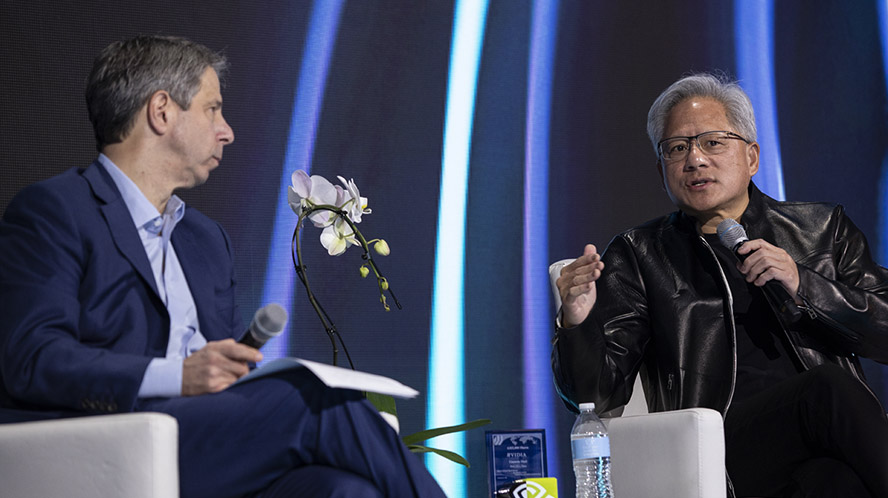
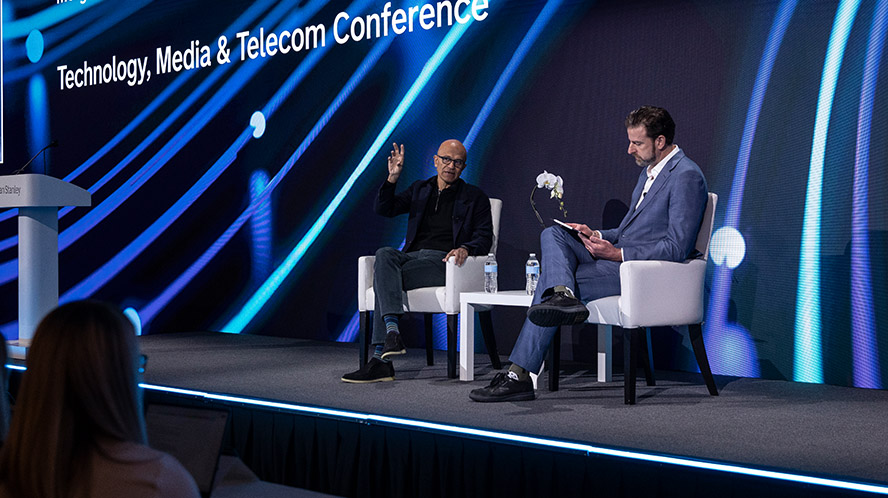
From the transformational impact of AI to new frontiers of innovation, we’re covering the most important themes shaping the technology, media and telecom industries from our annual TMT conference in San Francisco.
Quick Takes
See what Morgan Stanley experts heard from companies and investors in San Francisco with insights on the latest trends in AI and beyond.
Thoughts on the Market
Get our experts’ perspectives on the forces shaping markets on Morgan Stanley’s daily podcast, with our latest episodes on technology, media and telecom.



Insights from TMT Barcelona 2025
Jean Abergel on Emerging Tech
Jean Abergel, Global Co-Head of Media & Communication in Investment Banking at Morgan Stanley, highlights how AI could make it possible for businesses to do more with the same resources and capital—and what could be driving corporate activity in media as it relates to this emerging tech.
CNBC: Jean Abergel is the Global Co head of media and communications at Morgan Stanley. I've got a good anecdote about technology conferences in Barcelona we're now or afterwards. Ah, what a Cliff teaser, OK? Afterwards. Involves the king. OK, let's get to Jean first. How are you?
Abergel: Good morning. Very glad to be here.
CNBC: Look, if I was in. TMT, telecoms and media. Another and I had a certain job. I would be incredibly worried about my future because AI. If any sector it's going to, it's gonna have big effects on it. It's gotta be there, isn't it?
Abergel: Yeah. Well, definitely we see AI adoption. Across the whole economy, including in TMC. But if you look at in telecoms, for instance, which is the area our cover AI is going to help with the network automation. Customer management and also predictive maintenance. So that helps effectively do more with the same resources and. The same capital. Our research people estimates that over the next five years. Free cash flow margins could go up by as much as 400 basis points. Thanks to AI so we can do more with with the same resources. But over time, of course, people will have to be retrained. As Philip just said in the previous interview.
CNBC: Joan, this is my same problem. Retrain them to do what? Because the AI is only getting better, retrain them to do something that within a couple of years the AI is gonna be able to do better than them anyway.
Abergel: Well, look, you have you have customer interfacing functions that are difficult to be to completely automate. You have innovate. Innovation is also. A very difficult to completely disintermediate on the media space. Also content. There are forms of content that will be difficult to be totally. Produced by AI.
CNBC: Can I tell you something? The boss, Victor ribelli. It's amazing company Synthesia and they have this technology. I don't know if he's gonna be your comfort. They know where any language in the world. You can have a 7 slides and you can basically it can translate that into any language and have someone there an AI bot. Talking to the. Camp in any language in the world. I mean, that's taken out. Hundreds of interpreters straight away. It's amazing. Isn't it?
Abergel: Sure, sure. With, you know, those people have to be retrained to do other things, right? Some jobs will disappear, but there is no question that new jobs will appear to.
OK.
CNBC: You alluded to the media space and we've seen some huge reshuffling happening across the media space. In particular in the US, but it also in Europe. Whether it be Warner Brothers, paramount, Skydance, Comcast, our own parent company. There's just been massive transformation underway and it feels like really a reshuffling of these assets. What do you make of what's driving the reshuffle in this industry and and ultimately what are we going to be left with when the dust settles?
Abergel: So look what's what's driving corporate activity in media, because you're right. There is a huge amount of corporate activity is disruption and convergence. So the at the heart of it is the battle for customer attention and wallet. And in that context, differentiated content is key access to distribution. Critical and very importantly, the ability to monetize IP and customer relationship across the whole ecosystem. So that is conducive to corporate activity where it's MNA? Drone ventures or other types of partnership? So in summary, scale disruption and conversions, that's what's driving that trend.
CNBC: Just last week, a story emerged that Comcast is looking at ITV some of Ito's assets here in the UK. Which would mark Mark a a really doubling down on the UK market after Comcast acquired Sky about 8 years ago. How do you think about the UK market versus Europe versus the US here?
Abergel: Look, generally those become these industries are capital intensive as I just said and people will have to expand their audiences. They have. They will have to expand the ability, as I said. To monetize their investments and on the geography by geography basis. You'll of course have local macro that plays the role. But people look at this as a global business.
CNBC: The problem with TMT as an acronym was always the fact. And you know this way better than I will ever know. Jean as well is that. That you and I'll, I'll. I'll drop media out of this moment. You got technology on the. One side high high growth. Telecoms on the other side. Which is kind of. Virtually a utility by the time you get to. You know your main operators as well in in every country as well. So they take on the the latter take on vast amounts of debt. They build up all the infrastructure, but they don't get the goodies at the end of it. Whereas technology gets all the upside as well, is that still the case as far as you can see as well? Because that was my problem with the acronym at the START in the 1st 10 years of this century.
Abergel: Well, you're asking a great question because the reality is that there is no AI diffusion. If you don't have people to build the backbone of the digital economy, right?
CNBC: Take all the cost and the risk and the debt and and then the Googles of this world, the developers of the amazing software. They're the ones who. Get all the well treats. No.
Abergel: If you look at, if you look at what's happening today in the build out of infrastructure. AI related infrastructure our analysis estimate that $2.9 trillion of AI CapEx is going to have to be spent over the next four years. Right to build AI infrastructure, and that's mostly hardware, hardware and data center. And if you look at how this is going to be funded. Because that's the question you're asking. Half of that is going to be funded from free cash flows from players in the ecosystem. Mostly big tech and the other half is going to be funded from third party capital providers. So ultimately the the credit and the balance sheets that are being levered are less and less the telecoms balance sheet but more the hyperscalers balance sheet. Effectively.
CNBC: You talked a little bit about classifieds and in some some background research that you sent over to us. Classifieds and and the disruption that AI stands to bring to this sector. But also what I can bring it you know as a benefit to this sector and you know related story we saw. Right. Move come out on Friday. Say they're going to be investing in AI. Enhance the business, but it's going to take a lot. It's gonna take a lot of profits for the next few years and the market didn't like it at all. When it comes to decisions like this, company is the size. Of right move. Are we going to see more of internal investing? Versus partnerships, which the market seems to like a little bit more.
Abergel: What's happened last week is symptomatic that what will happen in some corners of the software industry. There is no question that those companies, they have very valuable assets. They have brands, they have customer relationship and very importantly they have a lot of data, right. If you don't have data, is not effective, right? So the question for them is how can they leverage those very unique assets that they have conduct themselves in an AI environment and sometimes they need to invest. And of course, investing in the short term. Sometimes market don't like this, right?
CNBC: Jean, I'm gonna ask you a very long, complicated question. But you got 36 to answer it. Cisco, the example of Cisco, Cisco was the Darling was the builder. Was the builder of the Internet or putting everything in place for that telephone revolution that we remember 340? Whatever it's shares have only just got back to where they were beforethe.com bubble burst as well. Is it? I mean, are we gonna see similar that the builders are gonna see a big downtick and take years to come back again?
Abergel: Look, if I if I give you my perspective on where we are in the market, right? The overall market is quite conducive to valuation levels, the. Free cash flow generation is very strong. Earnings adjusted. For profitability, we're still we're still way below where we were at the peak of the bubble in terms of PE. So overall, we we don't believe that we are in an overheated environment. Of course, some corners of the market, you know, are a bit too hot. We could have a pullback, but generally we believe that there is no real risk of a bubble or anything like this.
CNBC: I've gone over by about 5 minutes. Good anecdote. Very quickly I was at because your conference in Barcelona. I hope it goes better than this, Matt. All the great and the good of a certain industry. We're at this massive conference in Barcelona. I was there and I was doing the opening speech with this panel and it was gonna. I was really worried about my job, but honestly, the thing that went wrong beforehand. So the king was there. King Felipe and they on stage had him signing an my iPad to open. You know to welcome the conference. And started, the king went up. The iPad was locked. The King had his electronic pen. I mean, they they were so embarrassed. And then obviously when the organizer went up trying. I locked my life and they couldn't do it. And it's like it just reminds me technology plus the king bus. Barcelona, I hope you go better is coming to your conference.
Abergel: No, not that. Thank God answer but.
CNBC: Hey, you know, let's go wrong like that. They were so embarrassed. Jordan gotta leave it there. Thank you. Lovely to see you. Thank you very much for time, Jean Abergel, who is the global cohead of media and communications at Morgan Stanley.
More Insights


Sign up to get Morgan Stanley Ideas delivered to your inbox.
Thank you for Subscribing!
Thank you for your interest in Morgan Stanley Ideas.